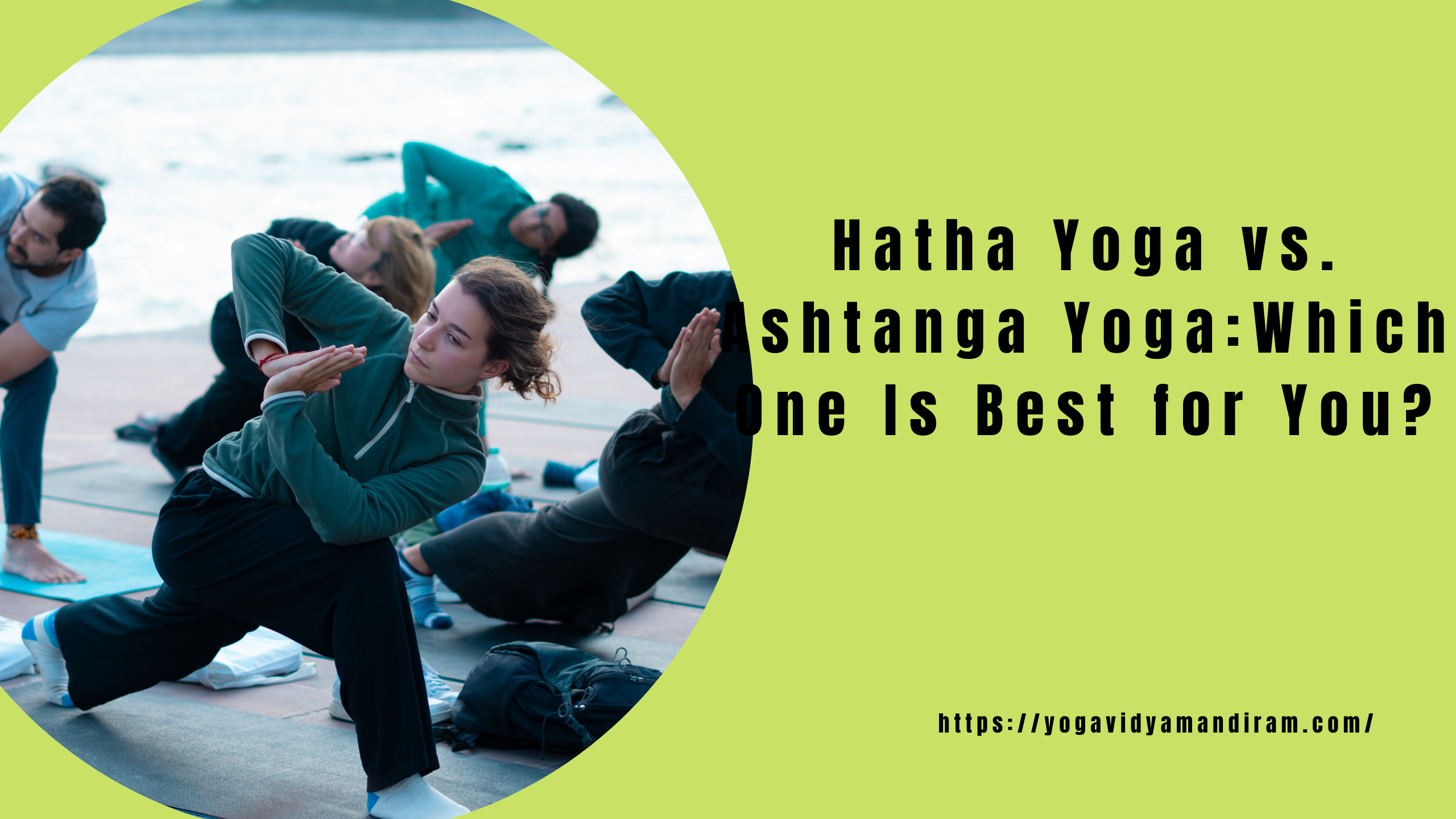
You have finally decided to get into the world of yoga but you are confused by a variety of options. You’re not alone! Nowadays, there are numerous types of style and schools of thought, so it may seem like a labyrinth to find the suitable practice. Hatha and Ashtanga yoga are among the most popular ones and all provide distinct ways of physical fitness and spiritual development. But what is the reason you know which one fits your goals, lifestyle and personality? In this blog post, we will decompose the main distinctions between the two dynamic practices, and you will help discover which one suits your body and soul. Though you want serenity or bustle in your practice, let us see how the mild flow of Hatha yoga practices contrasts with the hardcore sequences of Ashtanga, and find out which one is indeed the best one you!
Introduction to Yoga
Yoga is a worldwide craze that has managed to attract millions due to its ability to guarantee physical fitness and clarity of mind. When practitioners explore the large world of yoga, they usually come across the different styles that can meet the needs and preferences. Among the types of the practices that are gaining popularity, Hatha Yoga and Ashtanga Yoga are worth mentioning. They have great different advantages, philosophies and ways of practice.
You want to have a light introduction to mindfulness, or need an intense physical exercise, but the knowledge of these two styles can assist you select the proper path of your way. Hatha Yoga Teacher Training in Rishikesh is taking off with its unique features and benefits to the section of the population who is keen on intensifying their practice and at the same time have an opportunity to explore the rich heritage of yoga. We shall explore further what makes these two styles different so as to identify the one that best appeals to you!
What is Hatha Yoga?
Hatha Yoga is a type of yoga that is practised in most parts of the globe. It focuses on physical poses or asanas which are meant to bring the body and the mind together and relax.
As an ancient tradition, Hatha remains a root of most of the contemporary yoga genres. Its practice is based on breath control (pranayama), meditation and moral standards to develop an entire approach to well-being.
Hatha is usually a slower-paced practice that gives practitioners an opportunity to learn poses. This conscious investigation enhances increased sensitivity to physical sensations and thoughts.
The classes generally accommodate everybody regardless of their level of experience in the field of yoga. By its emphasis on strength and flexibility, Hatha Yoga welcomes people into the process of discovering themselves in motion.
Benefits of Hatha Yoga
Hatha Yoga is known to have numerous advantages that are both physical and psychological. Among the most outstanding opportunities are the fact that it is capable of promoting flexibility. The stretching of muscles and their loosening through practice make the daily movement exercises less difficult.
Relief of stress is another important advantage. Using conscious breathing and poses, Hatha Yoga encourages relaxation, which enables the practitioners to shake off daily stressors.
It also contributes to the clarity of mind. The concentration brought about by the focus on breath control assists in enhancing concentration which allows one to connect with oneself.
Moreover, Hatha Yoga has the power to increase physical power. There are numerous poses that involve the different muscle groups, and in case of many poses, greater stability and endurance will be achieved with time.
Finally, it is a very good initiation to a beginner who wants to experience the world of yoga without being overwhelmed by intensity and speed. This renders it to be available to everyone regardless of their age and fitness level.
Visit us: 200 Hour Hatha Yoga Teacher Training in Rishikesh
Characteristics of Hatha Yoga
Hatha Yoga is usually regarded to be the backbone of the contemporary yoga. It focuses on a moderate stance, the postures (asanas) with control of breath (pranayama). This combination brings about unity between the body and the mind.
Its emphasis on alignment is one of its major traits. Individuals are keen on the posture of their bodies at any given pose. This improves the safety as well as intensifies the gains of every asana.
The other characteristic is that it is slower. Classes generally create time to explore and be mindful. Students are able to feel unobtrusive sensations in their bodies thus becoming more aware.
Hatha Yoga is also inclusive of meditation methods. Still moments can be included in every session, allowing the mind to be free and calm in the middle of the motion.
Lastly, it is flexible at any level. Hatha can support a beginner or an experienced yogi to develop at their own pace, and therefore, it is not restricted to a specific group because everyone who wants to find some sense of balance can do it through practice.
What is Ashtanga Yoga?
Ashtanga Yoga refers to a dynamic and organized form of yoga that adheres to a given sequence of poses. It was developed by K. Pattabhi Jois in the 20 th century, with a focus on breath and movement synchrony.
The flow of practising is through six sets of poses, which are aimed at increasing strength, flexibility, and endurance. It is a fast-paced workout that provides a refreshing workout that is challenging to the body and mind.
One of the most prominent features of Ashtanga is its emphasis on Ujjayi breathing a deep, audible breath that helps to focus on. The technique assists the practitioners to stay in rhythm when transitioning between poses.
Ashtanga is a transformative experience whether you need some physical fitness or better understanding as a person. Its rigorous practice is attractive to the individuals who enjoy routine and advancement in their practice.
Benefits of Ashtanga Yoga
Ashtanga Yoga has various advantages that can change your physical and mental health. Among its main benefits, the increase in strength can be noted. Through a sequence of intense movements, the practitioners develop muscle tone as well as enhance endurance.
Regular practice also helps a lot in improving flexibility. The active movement stimulates intensive stretching that enables your organism to get more flexible with time.
The other significant advantage is higher concentration and attention. The more organised sequences of Ashtanga demand that you be focused in your mind enabling you to develop a better relationship with your breath and action.
Also, it is a style that encourages stress relief. The practice is rhythmic and thus helps in clearing the mind to enable one to go through the day with a clear mind.
Finally, Ashtanga encourages discipline and dedication. Adherence to a predetermined order helps in creating a feeling of routine which might be applicable in other parts of life than the yoga training itself
Characteristics of Ashtanga Yoga
Ashtanga Yoga stands out by being structured. It has a particular series of poses and enables one to be consistent and advance in the practice. The shows follow up on one another thus best suited to people who like routine.
Ashtanga involves breath control. The breath and movement are harmonized by the practitioners into a practice known as Ujjayi breathing. This improves focus as well as internal heat.
The other distinguishing feature is the focus on drishti or gaze point. Staying focused is a way of developing mindfulness and intensifying the meditative focus in practice.
Classes in Ashtanga may take up pre-defined times and may be physically straining. The moving back and forth necessitates endurance and perseverance, which is desirable to those interested in having a vigorous workout, as well as being able to develop spiritually.
Key Differences between Hatha and Ashtanga Yoga
Hatha and Ashtanga Yoga are equally popular styles, and they serve various demands. Hatha focuses on slow motions hence ideal to novices. On the contrary, Ashtanga is vigorous and strenuous.
However, unlike Hatha that is more about the alignment and breath regulation with the help of numerous poses, Ashtanga is based on a sequence of poses that have to be practiced in a certain order. This regimented way may be difficult yet rewarding to those who want to be disciplined.
The speed is also quite different. Hatha classes usually give the opportunity to dwell upon each of the asanas. Conversely, Ashtanga moves quickly between the poses giving it a dynamic nature that develops strength and endurance.
Also, Hatha is more accommodating to every level of fitness. On the other hand, Ashtanga demands a better degree of fitness, since it is demanding and involves constant motion during the process. The characteristics are distinct to each style and suit different people with different preference and purpose.
Which One is Best for You?
It is a matter of choice whether you want Hatha yoga or Ashtanga yoga.
Hatha may be the best bet in case you are interested in getting a soft introduction to yoga. It is also good to explore in a very comfortable speed, so it is perfect to beginners or those who are eager to relax.
Conversely, Ashtanga may be the place to be should you be attracted by a more energizing yoga which develops strength and endurance. Its regular patterns are capable of pushing your body in addition to offering mental concentration.
Think about what you want to do, do you desire calmness or challenge? The consideration of these points will assist in explaining what style suits your lifestyle even better.
The use of the two styles also can be helpful in determining which style fits you best. The most important thing in this journey is to listen to the needs of your body.
Tips for Practicing Both Styles Effectively
To practice Hatha and Ashtanga yoga effectively, start by understanding your body’s needs. Listen to how you feel during different poses. Each style offers unique benefits that can complement each other.
Begin with Hatha to build a solid foundation. This gentle approach allows you to focus on alignment and breath control without rushing through sequences.
When transitioning to Ashtanga, embrace the rhythm of the breath in sync with movement. The sun salutations provide an excellent warm-up for deeper postures.
Mix your practices throughout the week. Consider scheduling specific days for each style, allowing adequate recovery time while keeping things fresh.
Remember to stay patient and compassionate towards yourself. Progress takes time; it’s about self-exploration rather than competition.
Finally, consider joining workshops or classes focusing on both styles as they can offer guidance tailored specifically for your journey in yoga.
More Visit: 300 Hour Yoga Teacher Training in Rishikesh
Conclusion: The Importance of Finding the Right Style for Your Practice.
Finding the right style for your yoga practice is essential. Each form of yoga offers unique benefits and caters to different needs. Hatha Yoga, with its gentle pace and focus on alignment, can be a perfect fit for beginners or those seeking relaxation. It encourages mindfulness and helps in building a strong foundation.
On the other hand, Ashtanga Yoga’s vigorous flow attracts practitioners looking for a physical challenge and a deeper connection between breath and movement. This dynamic practice fosters discipline while enhancing strength and flexibility.
Consider what you want from your yoga journey. Do you seek tranquility or intensity? Would you prefer to ease into poses or engage in more rigorous sequences? Reflecting on these questions will guide you toward the style that resonates most with your personal goals.
For those interested in deepening their understanding of Hatha Yoga specifically, exploring options like Hatha Yoga Teacher Training in Rishikesh could provide valuable insights. Whichever path you choose, remember that both styles can coexist beautifully within your practice as they offer distinct experiences that contribute to overall well-being. Embrace the journey ahead—it’s yours to shape!
Leave a Reply